beauty · death · grandparents · intentional happiness

Sugar Shaker

My grandfather had shoes big as frying pans, and he used to let me stand atop them while he and I partner danced in his basement. He wasn’t particularly graceful, so I’d curl my toes to anchor myself as he slid us around the damp room that smelled of ping-pong balls — small strides for him amounting to large strides for me. A gentle giant with an Elvis lip-curl, he spent his workdays as a lineman for the phone company and his off-time, apparently, amassing records.

I can still hear the sound of a ’45 dropping down onto his treasured turntable, the staticky hiss of the needle as it made contact with the record. His record collection was so large, it filled an entire wall of shelves in his South Dakota home, and my sister and I would run right into that room almost the minute we arrived from Arizona for our visits. We’d be sure to listen to Walk Right In, Sea Cruise, Teen Angel — songs that propel me back in an instant when I hear them now.

Upstairs, my gorgeous and hilarious grandma would be snapping green beans from their garden, swishing around the kitchen in the ugly-prettiest polyester robe, floor-length and patterned in flowers the color of my childhood: harvest gold, avocado green, rust. Her filed fingernails, always painted a delicate pearlescent pink, were seemingly always prying and poking at foodstuffs in the kitchen (not likely what she wanted to be remembered for). “I’m never full,” was her constant refrain, usually said while squinting her eyes devishly, her front teeth tapping together as she crunched on a green bean, a crab leg, a pistachio — whatever was left.

If your grandparents are like mine were, they will thin their belongings as they age until there’s almost nothing left. The painted gray house with the cozy Murphy beds and garden will be sold when they move to a little apartment that’s gentler on the knees. The gold vanity stool on which your grandmother sat painting her nails the color of backscratches, or putting on fuschia lipstick from a golden tube, will be rehomed at her last garage sale. And the vintage record collection that lives in your soul will be quietly donated to charity after she passes away, your grandpa’s way of preparing for his own death: ridding his closets of things relatives might fight over.

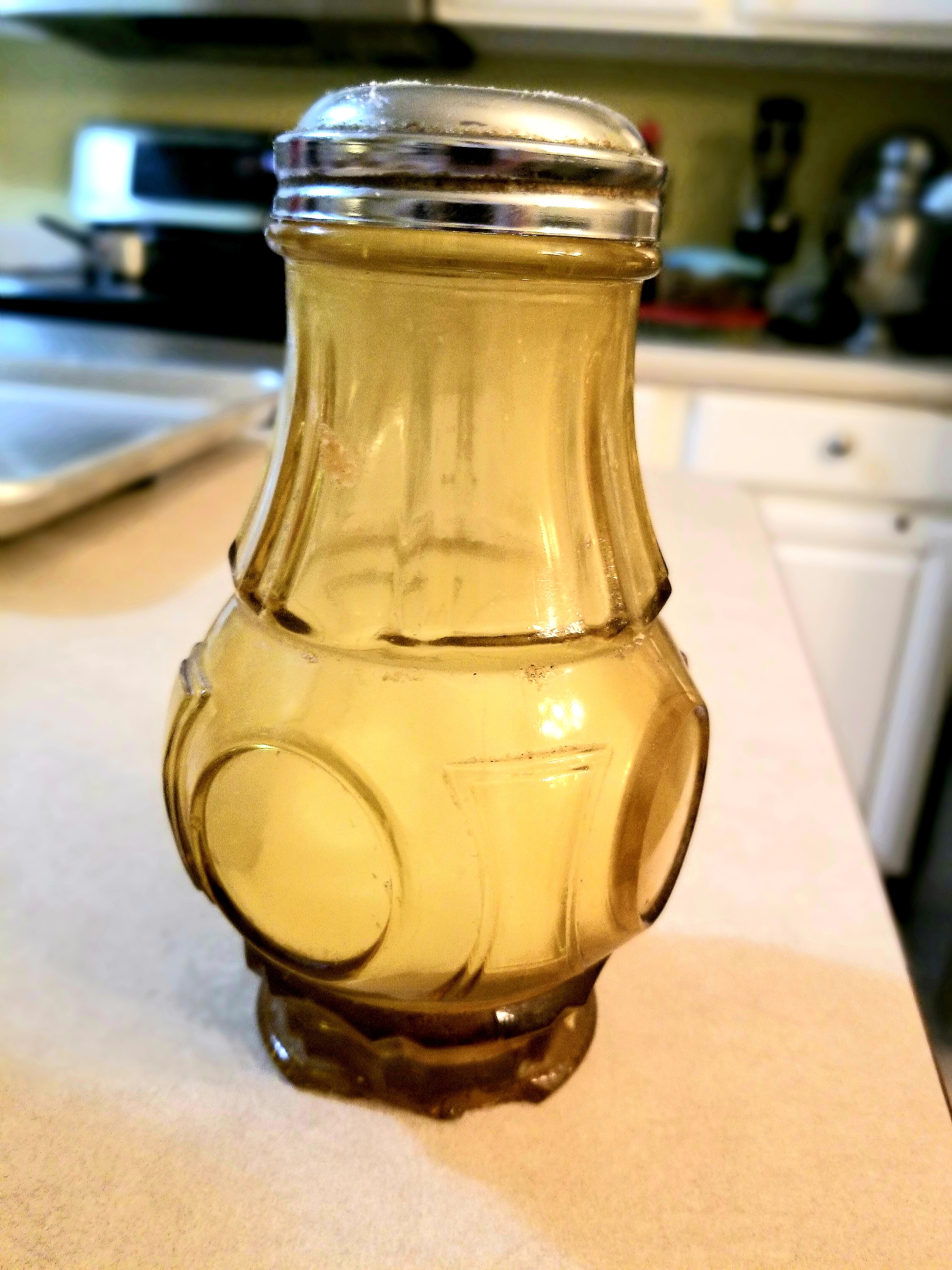
By the time my grandpa died, there was little left from inside that home where I danced atop his shoes — a mantle clock, some jewelry, a half-empty bottle of White Shoulders perfume. One exception was an amber-glass sugar dispenser with an aluminum top, likely purchased at a dimestore at a deep discount. I remember it on the circular table in the kitchen where my grandma snapped peas and, decades later, on the counter in their knee-friendly apartment. After my grandma passed unexpectedly in 2002, my grandpa took it with him to his assisted-living apartment. A Depression-era boy, he made such things last and last and last.

Today, it sits on my own kitchen counter, looking like nothing special but containing so much more than the sugar. Every time I use it, every time I look at the chipped base of it, I think of them both and their wonderful little house, their green garden full of mosquitoes and curling green vines, my grandmother’s hands tipping it over the last morsel of cold Christmas lefse, my grandpa’s hands tipping it over his coffee, and I know what a wonderful thing it is to have been their granddaughter.
daughters · death · grandparents · Grief

A Good Death (from the Momplex Blog archives)

It’s, what, maybe our fifth night at my grandpa’s apartment? I’m losing count now. We’ve been holding bedside vigil with him, all the women in the family, which is not a lot of women and yet nearly all of the family. My mom and her sister. My sister and me. Tonight there’s also my daughter. She’s only 10, but she asked to come. I wasn’t expecting this.

He doesn’t look like himself, I tell her. His mouth is open really wide—like this—and he’s gotten even thinner since you saw him on Thursday. She says she knows. She says okay. He’s gasping, and it sounds like he’s choking, I say. She just wants to give him a card she’s made. He won’t be able to see it, I say. You can tell I’m really scared. She has no idea what dying looks like. I’m just learning myself.

Of course, my dad has been coming and going. It’s “just” his father-in-law, but being that my dad’s own parents were killed in a car crash some 17 years ago, there’s a surrogate thing my grandpa wanted to do. Call me dad, Grandpa asked one day. And my dad obliged the man. This old man. This deaf old man. This man with finger joints thick as walnuts. This no-longer-towering man whose shoes I used to stand on to dance. Walk like a man, fast as I can, sang Frankie Valli. I can still see the hem of my grandpa’s pants swishing over his big Frankenstein shoes. I was so small. He was a giant.

As the giant shrinks, so does his world. Sure, he was always happy to see us, always greeted me with joy when his hunched-over body slowly climbed into my car. He always seemed tickled when he noticed, ten minutes into the drive, that the kids were in the backseat. “Oh, ho, ho!” he’d laugh. “Hello, little snipes!” But mostly he was staying home. Because it was hard to get to the bathroom. Because there were too many steps up to the restaurant. Because scooters don’t go over grass. Because it was too loud to hear. Because it was embarrassing. Because he was kind of tired.

“I’ve been sleeping all the time,” he told me just two weeks ago, when he happily agreed to go for coffee. It was the last time I saw him before he began this slow death. “Every chair I see looks comfortable, and then I sit in it, and it is.”

He’s gasping loudly in the bedroom, like he’s been doing for days. For the umpteenth time, I’m both surprised and secretly relieved he’s still alive when I walk into the apartment. My mom and aunt are playing cards in the front room, and the smell hits me in the face. It’s powerful, thick, and musky, a smell you stop noticing after just a few minutes, as I’m learning. I know it’s a smell that happens when old people want to live independently but barely can. But now I think it’s the smell of dying. I hate thinking that.

“Are you okay?” I ask my daughter. She nods, and we walk back to the bedroom. Great Grandpa doesn’t look like Great Grandpa anymore. I think it’s worse than she thought. But she’s okay. She wants to look, but she doesn’t want to look. She looks and looks away. I don’t know which one of us gives him her card. On the front she’s scrawled, “Get well soon!” But on the inside she’s written, “You’ve had a long life. I hope you enjoyed it!”

During the day, I’ll tell you we haven’t been sitting around crying and wiping our noses constantly. You can’t do that 24/7. Yes, we cry. But we also play card games and board games. We laugh and tell stories. Today my sister takes my daughter for a ride around the complex in his scooter. We time each other to see who can get from living room to fridge and back in the scooter in the shortest time. We eat junk food. But my favorite part is the singing. It’s my favorite because I think the rest might confuse my daughter, or maybe me. Of course, I want her to know it’s okay to be okay. I don’t want her to be devastated—and she isn’t—but I don’t want her to get too silly either. I’m not sure it’s the coping mechanism I want to model. That’s why I love the singing.

We gather around my grandpa’s bed, and we sing songs he loves, including “Me and Bobby McGee,” which sounds a lot different when you sing it to an old man who loved it, an old man who’s actively dying. My mom and aunt can sing in harmony. My daughter has a pretty little voice, and it’s coming at me from over my shoulder. I want to cry. We try to sing my grandpa’s favorite hymn, “Just a Closer Walk with Thee,” but we don’t know all the words. My sister looks them up on her iPod so we can sing along, and we do, but the last verse is missing. So, we try a different version, and when we sing the last verse, I see my grandpa’s face clench up a little:

When my feeble life is o’er,
Time for me will be no more,
Guide me gently, safely o’er
To Thy kingdom’s shore, to Thy shore.

The hospice nurses keep telling us it won’t be much longer, maybe today, maybe tonight. He hasn’t had any fluids or food for nearly a week. This is imminent, they say. But it never is. “It’s inhumane,” I told my mom when she asked me yesterday what I was thinking. “This is inhumane.” But now I know that every day has been for something. Every painfully long day that his tired old body has clung to life, has allowed us to do one more sacred thing before he goes. And another. And another. Today it was hearing my daughter sing to her dying great grandfather, to experience the beauty of all these strong women—I’ll count my little girl among them—carrying along a strong, sweet man through the tough work of dying.

After a week, my grandpa finally passed one evening with my mom and aunt at his side. He died with my daughter’s card in his hand, and after we washed his body and prepared it to go, my aunt returned the card to the same place. That’s an image I’ll never forget.

I sense a song coming on.

babies · grandparents · happiness · intentional happiness · motherhood · speed-posts

Not Done Yet: The You Your Kids Haven’t Met Yet (from the Momplex Blog archives)

My living room walls are painted the color of old Coors cans. It’s a sort of muted golden yellow. I didn’t even realize I’d chosen Coors yellow until this week, when I got to feeling sappy about my childhood. The walls have been that color for five years. How could I miss the connection?

wall

Source: Lovelypackage.com

Coors Banquet Beer made regular appearances at my parents’ neighborhood barbecues when I was a little kid. And I can still almost taste the sweat I’d swipe off the cold ones, freshly popped by my dad and other mutton-chopped men, after golf tournaments in the crusty mining town we called home. They’d scoop them with their gloved hands out of ice barrels near the patio where their scores were posted. I can still hear the hot locusts buzzing as I sat cross-legged in a shady spot watching them, my hair smelling like chlorine and the sun-blistered skin on my shoulders starting to peel. I liked being there around all the dads. They looked mighty high on their low handicaps and tossing back those Coors.

I don’t remember my mom drinking beer, even though she’s the one out of my two parents who will indulge in a cold one now and again. “I never really was a drinker,” I’ve heard my dad say. I can’t argue with that. Knowing how memories go, there were probably just a few backyard barbecues and not nearly so many sweaty Coors cans as I like to imagine. We fudge our childhood memories a lot, maybe more than we think. And some of us take a longer time than others to realize it wasn’t all about us.

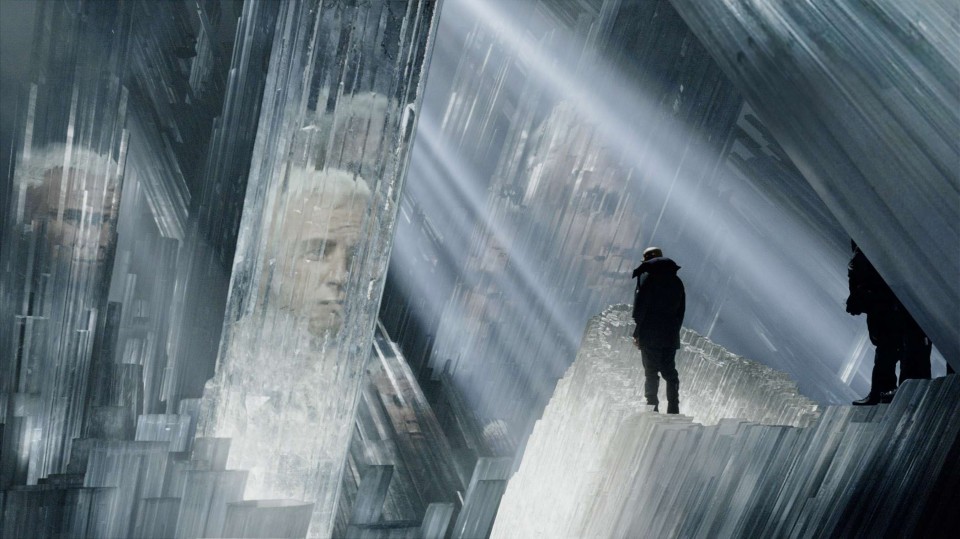
I spent this past Saturday in a primitive little hilltop cabin for a quiet getaway with my mom. We had no electricity or running water. The bathroom was an outhouse about 30 feet from the cabin. Snow was up to our knees in some spots, and we had only a wood-burning stove to warm our food. We took little hikes and naps and read quietly from our books. We ate homemade chicken-noodle soup and salad by candlelight and corked a bottle of wine using a shoe and a steak knife. (By God, we were going to open that #%$&* bottle!) At night we curled up together in a loft bed and talked. In the morning we chatted and giggled before heading out to build a snowman and then stab the snow with so many pretty icicles, it looked like Superman’s Fortress of Solitude.

Wait, I think I'm overstating the awesomeness of what we created. (Source: Wodumedia.com)
Wait, I think I’m overstating the awesomeness of what we created. (Source: Wodumedia.com)

None of this was the elemental thing of it all. No, the whole point, for me, was discovering that my childhood version of my mom wasn’t the “real” her.

My mom stayed home taking care of my sister and me for a long time. She and my dad were close friends with several couples that also had kids, and when we congregated, there was drinking and loudness and so much hilarity, the kids running wild and staying up a little too late and all of us playing games of badminton or cards. We were happy and nuts. I can still see my mom laughing and smiling in all these scenes.

When I was in college, she started to change. In fact, though she’s always been an angel to others, over the years, she’s become almost obsessive about helping the elderly, the mentally ill, the poor, animals—just everyone and everything that breaks your heart. Her latest thing is the fight against human trafficking. Sometimes talking with her is depressing. “Mom, I’m sorry. I know you think some of these death stories are sweet,” I remember telling her when she was working with hospice, “but they just terrify me.” There is sadness all over the world, and she can’t just relax. Sometimes I just wish she’d be her old self. I miss the real her.

But as we talked this weekend and I told her how much I hate these Wisconsin winters that I was never cut out to endure, she said this: “Imagine that you’re sitting behind our old house in Arizona, and it’s 100 degrees out, and the LAWN has just been put in—a lawn has been PUT IN—and you’re staring at the wall of dirt over you, where they’ve just cut through the earth so you can have a house, because they just did things like that. And flies are buzzing around your head, and you think, ‘This is where I live now, and I’m going to just live here for a long time, and this is it.’” She explained to me how she made a good life there, how she sought her friends and found ways to make it work, but the things that gave her days meaning were not the things I would have expected. It sure wasn’t the Coors banquet beer cans.

And that’s when it hit me, how blind I’ve been. I know good and well my kids don’t really know the whole me. They have no idea what a detour was taken when we decided to have them—before we moved to a town with polar vortexes that make me feel murderous. Before I quit my editing career to raise them. Before I put on stretch marks and wrinkles. Before I learned how to speak in whole G-rated paragraphs. Before I knew anything about time-outs or changing diapers or making sure homework gets done or shoveling snow or volunteering on school committees or teaching Sunday school—or, really, most of the things they’ll probably remember about me at this age. They have no idea that, like them, I’m not a finished product. There’s more than meets they eye. I’m still becoming something, and I may become many more somethings before I’m done.

So, that pretty much tells you where my “real” mom went. She went to the cabin with me this past weekend. Turns out she’s been with me all along.