dads · daughters · grandparents · healthcare · transplant

How Parenthood–and a New Heart–Taught Me to Appreciate My Dad (from the Momplex Blog archives)

For six months, I had a battery-operated dad. This is different—significantly—from having a battery-operated “boyfriend.” (We all know what that looks like.) My dad’s battery was a big, heavy square that fit into a wearable pouch given to him in the cardiac ICU. He’d just had open-heart surgery, and the battery connected to a tube that ran through a grotesque little hole in his stomach and up to a device that helped his heart pump. The hole and the device, called an LVAD, were put there on the advice of Mayo Clinic doctors. That’s because my once healthy 62-year-old dad had rapidly and suddenly plummeted into acute heart failure over the six months prior. The doctors called it a mystery of sorts. And they called the LVAD a bridge to transplant.

Before any of this happened, I had a long stretch when I didn’t get along with my dad, for about 15 years. I tried. He tried. But it was really strained, and our fights were poisonous. However sweet my earliest memories of him, they could not support the weight of our inharmonious personalities as I grew up and developed opinions (and hormones). Tender days of horsey-back rides faded miserably into the distance as I traveled the roads of adolescence and beyond. For a time, I suspected he didn’t even like me. Loved, yes, but not liked–and the feeling was mutual. During my mid- to late 20s, we managed to tread lightly around each other, which had the effect of looking like we’d made peace. But sometimes the veneer would crack open. Angry tears were never far away for me.

When I was 31, I gave birth to my first child, a cherubic little girl, and my dad became Grandpa. He was smitten. I have a picture of him sitting next to her on the brightest green lawn during her second spring. He’s showing her how to make a blade of grass whistle. The conversation looks serious, resembling a  photo my mom keeps on the fridge, one of my dad having a fancy tea party with their neighbor’s toddler. Lace gloves were involved. Tiny teapots. In the picture, my dad has the same thoughtful look, like he’s at the labor-negotiations table again. He’s really at that party. I’m a grown woman, but when I first saw the picture, it made me jealous. Why didn’t my dad do those things for me? Why didn’t get that guy?

At least my daughter got him. And as I watched his delight in her unfold, as I walked my own path as a parent, I forged a bridge of empathy toward him. I learned what he’d meant when he once admitted he always loved but didn’t always like me. I learned how hard it was for him to temper his cutting words, because I struggle with that same flaw as a parent. I learned that even the most lovable kids are exhausting. I discovered that sometimes, yes, you’d rather lick an outhouse than play another game with them, especially if it involves you doing voice-over for their toys. I learned that it’s easy to be strong out of the gates but hard not to get whittled down. Mistakes pile up, and you worry you’ll be remembered in the worst light—not as the horsey-back parent you once were but as the parent you became, the one who sometimes lost her shit over nothing.

My daughter was eight and my son was three when Grandpa became battery-operated. I was sick with worry but tried to hide it from them. The thought of them growing up without him, forgetting him even, was overwhelming. Ambulance sirens in the distance would give me an indigestible mix of sympathy and anticipation that’s hard to explain to anyone who’s never awaited a life-saving organ donation. Every time I watched the MedFlight helicopter zooming overhead, the yin and yang of it would choke me up. “Let’s pray for that person to be okay,” I’d tell my kids. And we would. Guiltily, anxiously, I’d wonder if the sirens signaled the phone call my family had been waiting months to receive.

On November 10, 2011, just after noon, I got that call.

“Dad, I’m in a meeting,” I loud-talked into the phone over the din of the restaurant. I was having lunch with a client. “Did you need something?” He was yammering away, and I kept repeating more loudly that I was in a meeting.

“I have a HEART!” he finally shouted. “They found a match.”

The first thing I did once I stopped blubbering into my lunch was to call my daughter’s school and have her pulled from class. As I collected her into her seat and steered toward the sitter’s to pick up my son, I finally divulged to her how very serious this surgery was. I’d held off until then, because I hadn’t wanted to scare her. And, selfishly, I hadn’t wanted to field questions that would scare me. Kids ask hard questions.

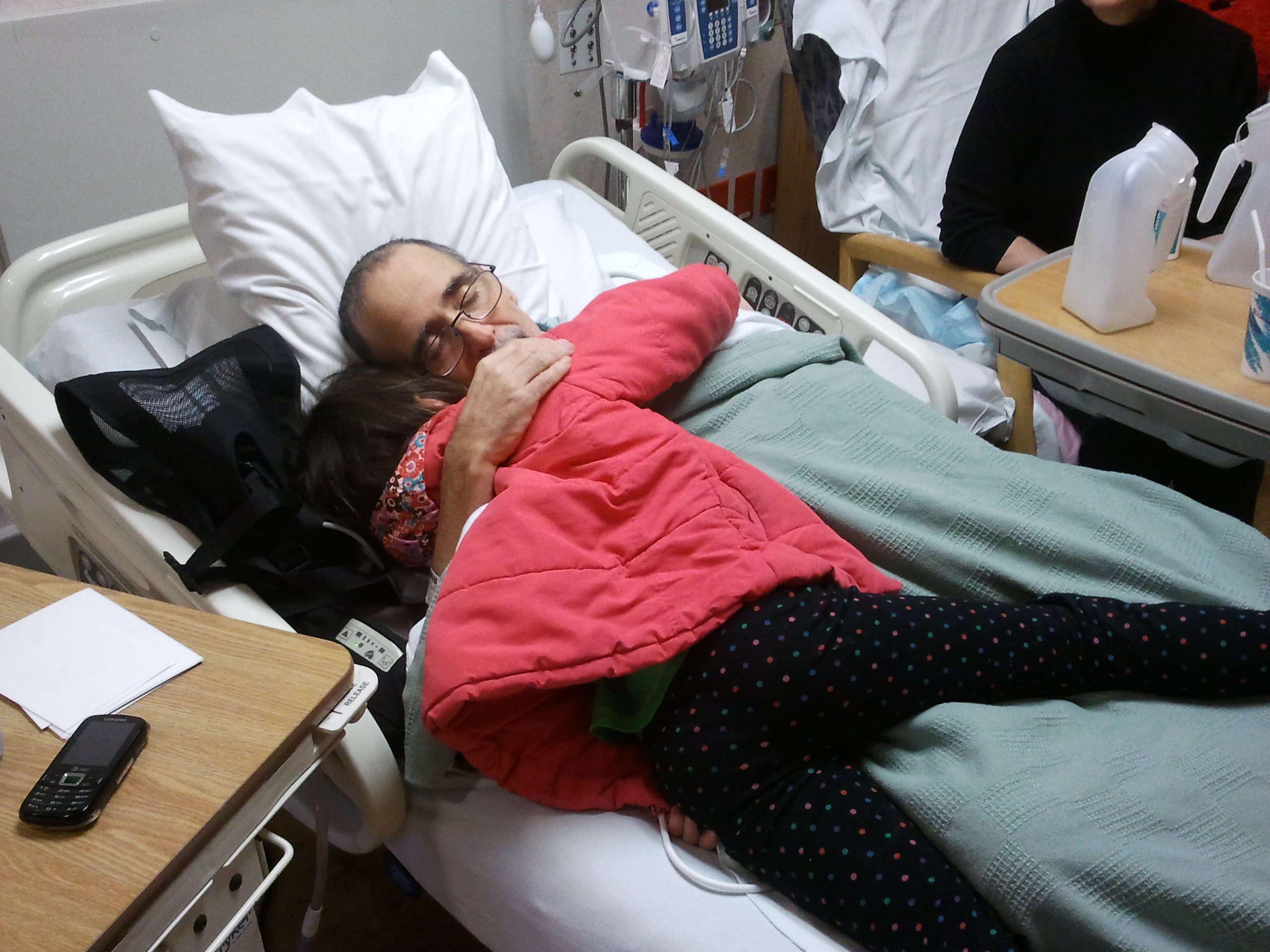
In the rear-view mirror, I saw in my daughter’s eyes the most penetrating concern and hope and love. She just wanted Grandpa to be okay. And I felt the feelings right along with her. I wanted him to live long enough for her to remember him, for my son to get to know him, and for me to tell him I was happy to have him back, warts and all. Thanks to one amazing stranger, one generous donor, that’s exactly what happened:
SAMSUNG

advice · daughters · healthcare · motherhood · preschoolers

Psychobabble (from the Momplex Blog archives)

This won’t be pretty. There will be blood, lots of it. Your hair is going to fall out in big clumps in the drain. You might become chronically anemic. It will be expensive, of course. And you’ll never sleep well again. Get yourself a good chiropractor and therapist. Vomiting is a given. So is diarrhea.


No, it’s not cancer, ma’am. It’s parenthood.

I make no apologies about being the one who made the call to the psychotherapist for my preschooler. Yes, I’m the one responsible for the hour we spent today in the tiny office with the soft chairs and the pretty dollhouse with the multiracial dolls wearing clothes that I could only presume covered anatomically correct bodies. I’m the one who decided it was time.

“I’m going to show you a sliding scale,” the doctor says to my tensed up child. “The top of the scale is the most scared you could ever possibly be, and the bottom of the scale is not scared at all. You move the slide to answer my questions. Ready?”

My daughter nods, clutching Cake and Frosting, her stuffed cats that happen to be wearing gorgeous Barbie gowns, a Mary Kay pink-daisy keychain, and various tacky scarves. I mean, they’re wearing the trash basically. I realize after we arrive that the therapist is taking in the whole scene of my daughter and me, and these annoyingly accessorized cats give a total irrelevant and false message about who we are.

“Okay,” the doctor continues. “What if I say the word shot. How does that make you feel?”

My daughter moves the slider up about midway and clenches her teeth. The doctor can’t tell, but there are tears being held back. Cake and Frosting are damn near being suffocated.

“What if you were to get a shot? How would that be for you?” she continues.

My daughter shoves the slider to the very top, making sure it can’t go any farther than where she’s pushed it.

“Okay. What if I were to just put a shot on the chair over here?”

My daughter moves the slider down just a smidge. It stays there for the remainder of the questions: What if we put a shot without a needle over there? What if I asked you to give Cake a shot? What if, what if, what if.

I explain about the wasp sting three years ago, how my daughter has come to associate it with shots. I don’t know why. Who knows why kids think as they do? I explain about the screaming when she sees a hypodermic needle, even in cartoons. I explain about the doctor’s kit that my daughter obsessed over for more than a year, how we didn’t realize for that long that she and her friend were giving each other pretend shots where — well, where they shouldn’t have been putting things.

“In their private parts?” asks the doctor, instructively.

“Yes, in their vaginas or thereabout,” I respond, instructively. “So, we realized my daughter had been trying all that time to work something out. I’d told her at some point, when she asked about it, that shots are usually given in the arm, leg, or butt. I didn’t realize that the meaning of butt wasn’t entirely clear to her at the time. To her, butt was the whole vicinity of the crack, front to back. So, basically we’re dealing with a fear rooted in a misunderstanding from when she was two, one that had her thinking shots feel like a wasp sting, and possibly in the vagina. That’s what’s up.”

“Aaaaaahhh,” says the doc. But she doesn’t really say it like that. I just think I hear her thinking it like that.

I like her actually. I like how funny she is, how she explains shots are given usually in muscles and then proceeds to demonstrate how the butt is a big muscle. I’d already explained this to my daughter, of course, but the doctor does it better. “When I squeeze it, I go up,” she says, rising a little off her swivel chair. “When I let go, I go down.” I’m in stitches, to be honest. She’s going to be great.

But then she asks my daughter this question: “Does your mom worry a lot? Is she a worrying person?” It makes my skin feel too tight. I’m not a worrying type. I don’t think I am at least. I’m careful, yes, and conscientious and protective, but not at therapeutic levels. I’m proud when my daughter says I’m not a worrier.

When the doctor asks whether my daughter sees me cry a lot, I laugh. This one doesn’t make me nervous. It’s part of our life. My daughter has seen me cry quite a bit, particularly when my husband was deployed. So, I’m amazed at the answer. “One time, when she was pregnant,” she says, “in the bathroom after she threw up.” (I’ve got a bipolar-spectrum disorder, people. My husband was gone for 15 months out of my daughter’s five years on Earth. Her apparent forgetfulness assuages.)

“Is she playful?” the doctor continues. She’s totally drilling. My daughter smiles and nods. “Does she hug you a lot?” WTF? I feel like I’m headed for the gallows for some reason. It’s like watching my daughter on stand at court, being questioned about the kind of parent I am. What face am I supposed to be making during this interrogation? Can I hold my daughter’s hand, or will that be perceived as manipulation here?

“You know what she does?” my daughter says with a burst of laughter. “She gives me a hug and says, ‘Let’s see if we can become one!’ And then she squeezes me really, really tightly, but then when we come apart, she says, ‘Awww, we’re still two.'”

I’m kind of proud watching her burst out of her shell with such a show, maybe even blushing. Don’t you know how it is? How you question whether you’re doing an okay job every day of your parenting life? How good it feels to get some affirmation that the good stuff is sticking? But then I see the doctor’s expression, and it’s not good.

“Mom,” she says to me, prescriptively. “She needs to be her own person.”

Here’s where you can picture a balloon deflating, a leaping gazelle being shot in the neck, or a space shuttle exploding just after liftoff.

You know what? I call bullshit. I’ve lost hair over this kid. I’ve bandaged her blood and cleaned up her vomit. I’ve lost sleep when she stole it. I’ve lost friends and time, too. But I’ve never been a smother mother. A let’s-become-one hug to make her laugh is not a metaphor for our relationship. It’s me trying to kill time between playing plastic horses. It’s lighthearted fun.

“She is her own person,” I say, refraining somehow from gesturing at my daughter’s ensemble, a garish swimsuit-fabric pink dress with gold detailing that would have done Mrs. Roper proud, paired with turquoise-and-gold argyle tights and broken green Crocs. “She just so happens to be a person afraid of shots.”