friends · Globe · intentional happiness · Past life

Miss Mayo

Have you ever donated blood? Until yesterday, I hadn’t. My only previous attempt was in the late ’80s, at a blood drive at my high school, when I was told my veins were too small. I’ve always assumed that there was no reason to try again, but yesterday I had three reasons to check that assumption:

  1. My mom, herself a regular blood donor, recently needed a blood transfusion following one of her chemo treatments.
  2. A new friend I met for coffee over the weekend, who was en route to donating platelets, shared with me a stunning story about a beloved member of her extended family surving a mass shooting thanks to donated blood.
  3. I’m actively looking for ways to find or (even better) manifest joyful things in my world that lead me away from hopelessness and into gratitude.

When I walked into the Red Cross donation center, I explained to the receptionist, a volunteer, that I had a 5:40 p.m. appointment. She looked on the day’s schedule but found my appointment time was blank–no name written there. “That’s OK,” she said, “I’ll write you in.”

I have an Italian surname that trips up most Americans, but as I enuncinated each letter after saying it, her pen was already moving one step ahead of me.

“I know how to spell that one,” she said. “I used to teach in a little town called Globe, and I had a student–“

I gasped and pointed a finger at her.

“Mayorano!” I said.

Her eyes lit up as it dawned on both of us that this was my fifth-grade teacher, whom I have not seen in nearly 40 years. She jumped up from her chair as I ran around to her side of the reception desk to hug her.

“Miss Mayo” used to teach math and didn’t suffer fools lightly. I don’t think I ever got caught in her crosshairs back in those days, but my memory is that she was not particularly warm, maybe even a little mean. She didn’t look much different yesterday except that her jet-black hair that used to hang down to her rump was now shoulder length and pulled back in a ponytail. “You’ve barely changed!” I said.

I couldn’t have been more wrong.

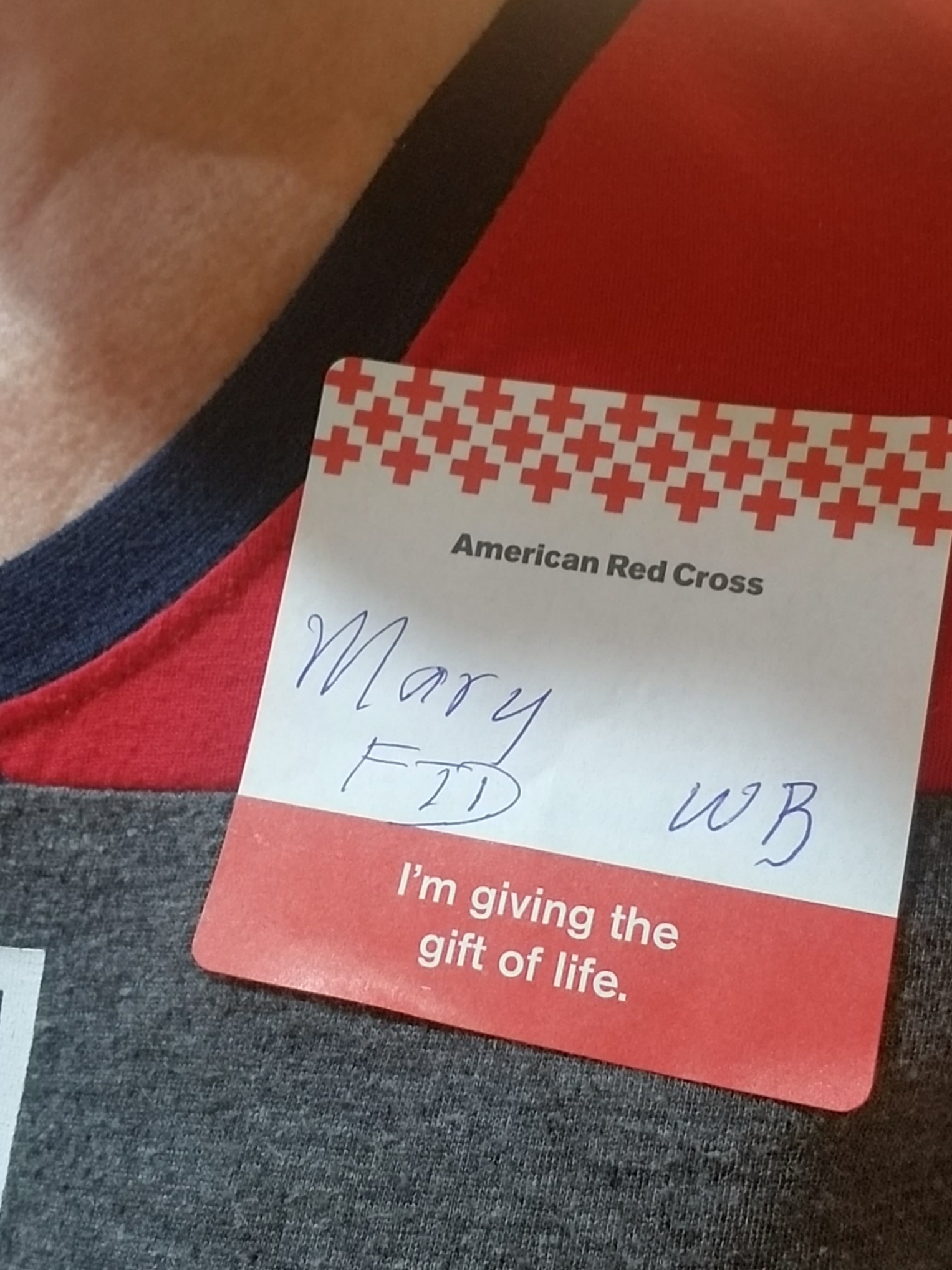
We talked for a long time before I was taken back for admission, and her warmth washed away my nervousness. Then she came and held my hand while the young tech successfully fed a needle into my little Fisher-Price vein, her company keeping my mind off the blood flowing down through the tube. (He kept calling me Mary, which is my mom’s name, even after I’d confirmed several times that my name is Jenny. I didn’t realize why until I got home last night, when I saw that Miss Mayorano had inadvertently scrawled my mom’s name on my name badge when asking how my parents are.)

After I finished my blood donation, Ms. Mayo and I sat together in the post-donation fuel-up area, where Red Cross keeps the snacks and juice. We laughed as I recalled how she always had in her bottom desk drawer all manner of candies, which only the best-performing students were (sparingly) invited to shop. We exchanged stories about our paths in life and where others we both know have ended up, including my old junior high gym teacher, who remains one of her closest friends and whom she texted on the spot to tell about our chance meeting. We then commiserated about the heartache of divorce and making new friends at our age. She told me about her travels and work and how she spends her days now, and I told her about mine. I did the math in my head when she casually mentioned her age, and realized she was only 21 or 22 years old when she was my teacher: a baby!

On our way out, “Miss Mayo” slipped a scrap of paper into my hand. It had her name and phone number scrawled on it in familiar handwriting that I remember from a chalkboard in 1983.

“I’ve been really struggling with work and life and just feeling not quite myself these days,” I told her. “So, I’ve been doing an overhaul of sorts and being very intentional about finding something that makes me happy each day. I thought today it would be donating blood, but as it turns out, it was you. You’re my happy moment.”

There have been many days after days lately when my well has been empty, and I feel like I have nothing left to give after I clock out. It all goes into my job, which regularly spills over into weekends and evenings, into every conversation, and away from the things that matter most in life, like my relationships, caring for my soul, and being alive to the bigger world around me. What a terribly unfulfilling habit this has become over time, leaving me with a sense of having to scrape together bits and parts from what’s left inside me in order to show up for my life! Now happily, happily, I am rediscovering that not all giving from the well drains it. Some fills it up.

To donate blood, visit Red Cross Blood Services.
Past life · speed-posts

Reality, Circa 1975 (from the Momplex Blog archive)

I was born in a hospital owned by a copper mine in a so-called “company town.” My first vision in life was undoubtedly a pair of cowboy boots, worn by the obstetrician who delivered me. He’d come fresh from a golf game and not the annual rodeo or horse races. I’m told he was miffed that his 18 holes were interrupted by the work of catching me. But, if you think about it, I paid for his country club dues.

The country club was owned by the mine, too. So was our family’s house, before my parents bought it on the cheap. Maybe twenty thousand was big money then, but the house—on executives’ row—was modest and small: cream-colored clapboard with white trim, plopped in the middle of a postage-stamp yard. I used to hide under the porch stairs, only slightly less fearful of the cobwebs than I was of being found during hide-and-seek.  I accidentally hanged myself once in the backyard, and I can still see my little friend Darran fleeing as I dangled from the swing set. My mom happened to look up from the kitchen window just then, and came out just in time to slacken the jump rope.

Inspiration Hospital was just up the road, a regular weekly stop for us, but rarely for things as serious as a hanging. We went because my big sister required weekly allergy shots. When the nurse would tell her she’d been a good boy, which was most days, my sister’s eyes stung with tears. She’d shuffle angrily down the linoleum hallway wearing her sheriff star, faded t-shirts, and jeans. Her straw-straight hair was knotted as a spool of thread from the bottom of a sewing bag. Because people often mistook us for twins, and nobody ever called me boy, I wondered what was so special about her.

My sister had chronic ear infections and was, by all accounts, a grumpy child. One day, like many other days, we left from the hospital with a prescription in my mom’s hand. My sister sat slumped against the passenger-seat window with a fever. I happily jabbered in the backseat, anxious to get to the store where the drugs were dispensed. Along with filling prescriptions, Sprouse Reitz also had aisles and aisles of fabric, a shelf full of Barbie clothes, and a row of gumball and candy machines.

“Can I go in?” I asked. My mom was smoked from caring for a sick child, and I was always asking inconvenient questions like that—always talking, in fact. “Please?”

“You can come in.” Her lips were pinched tight. Even at seven years old, I knew she didn’t want to cart me along. Maybe she worried my sister would hit me if I stayed behind in the car. That sort of thing happened sometimes. “Just make sure you stay with me,” she added. “Don’t wander.”

Once inside, I roamed to the candy machines at the front of the store while my mom spoke to the pharmacist in the back. If I looked at the machines longingly enough, hungrily enough, I was sure my mom would cough up a dime. But after what seemed like a few minutes, my reverie was broken by the sun flashing off her car as she drove away. I was pretty sure she meant to do it. I felt this in my gut the same way a seven-year-old just knows her stuffed animals talk at night.

I don’t remember if I whimpered or wailed, but soon a woman with very thin hair and a diameter twice her height came over to help me. Her name was Mrs. Davenport. That much everyone knew. She was almost as short as me but had a chest that went on for days, like two sleeping bags rolled under her blouse. “It’s okay, honey,” she said. “Did you lose your mommy?”

I didn’t want a new mommy, and my gut told me that’s exactly why she was asking. She hugged me so tightly, forcing my head into the dip between her huge breasts. “It’s okay,” she said. “Do you know your phone number?”

Of course I knew my number, but in my panic—and hers—the call was placed well before my mom had a chance to make the 20-minute drive home. In those days, before voice mail and pagers and texting, if someone didn’t answer, it was tough luck. Sweet Mrs. Davenport hung up and stroked my hair with the thick fingers of her small hand. I didn’t want her touching me, but I had no right to say so. I was only seven, and she was going to be my new mom now.

It stuns me as a parent now, how immediately sure I was that my mom meant to leave me there. Wasn’t everything a parent did intentional and deliberate? Each decision perfectly considered? Each choice a reflection of my value? I’d been told not to wander. Being abandoned was the consequence. It never occurred to me it was an accidental one. I think about that sometimes, the omnipotent and prescient power my kids think I have.

Eventually my mom returned to the store—maybe 45 minutes had passed—and scooped me up in her arms. Her voice was calm, reassuring, and wracked with sugar-coated guilt. My sister had known the whole ride home that I wasn’t in the car, but she wanted her bed and some medicine. “Why are you so quiet back there?” my mom had asked, before realizing I wasn’t “back there.”  When she reached me again at the store, still being smothered by my new mom, she looked much like she looked a few minutes after the hanging. It was a false calm, talking a little too fast and smiling a little too hard.

“I want to see my neck,” I’d asked on my hanging day a few years earlier. “It feels funny.” I remember Sesame Street was on the tube, and I was curled up under a blanket on our itchy goldenrod couch. My throat felt funny, like an unshelled walnut was lodged in the center. So much for that game of cops and robbers.

“You don’t need to see it,” she said, stroking my hair. “It’ll scare you.”

“It won’t scare me,” I said. “I want to look.”

She thought for a minute, then walked to the back bedroom and emerged with a hand mirror. I looked at the parallel lines of rope burns around my neck, cherry red and gradually diminishing to a point, like a tornado—and I burst into tears. “It hurts!” I cried. “It hurts so much!”

“It’s okay,” she told me gently. “Everything’s okay.”

I don’t know why I believed her. From the start, there’s been evidence things aren’t that simple: cowboy boots in the delivery room, nurses that call little girls boy, cobwebs in my hiding places. I believed her then, as I’d believe her for years, even though my friend had left me hanging from a noose, behind the fluttering white sheets that danced a beautiful dance on our clothesline.

Home, circa 1975
Home, circa 1975

career · happiness · intentional happiness · motherhood · Past life · preschoolers · writing

See that Mountain? Redefining Glory Days (from the Momplex Blog archives)

The month before I graduated college, one of my writing professors approached me to ask if the university’s English department could use my senior writing portfolio as a model for future classes. She said it was one of the best she’d ever seen. My sophomore year, there was some sort of essay-on-demand writing-proficiency exam required for all sophomores, and my graded essay came back with a letter saying it was so good, the grader had stopped the rest of the judges to listen to it read aloud. True stories.

My husband and I used to be cemetery fanatics. This one, from Savanna, was always one of my favorites. It was next to the husband's headstone, which was about 10 feet high and inscribed with every freaking thing he'd ever done or joined. Go ahead. Click on it. Behold the last line of the epitaph. That's what I call honest. Makes her husband look like a narcissistic wiener.
My husband and I used to be cemetery fanatics. This headstone, from Savanna, Georgia, was always one of my favorites. It was next to the husband’s headstone, which was about 10 feet high and inscribed with every freaking thing he’d ever done or joined. Go ahead. Click on it. Behold the last line of the epitaph. That’s what I call honest. Makes her husband look like a narcissistic wiener.

I think about these experiences sometimes, mostly how they make me feel (and sound) like Uncle Rico from Napoleon Dynamite: “See that mountain over there? What do you want to bet I can throw this football over it?” He takes his bite of pan-fried steak, his hairpiece glistening, and, oh, it’s such a pathetic sight. I guess I’ll take comfort in knowing I’ve done a few things between my supposed glory days and my current life.

It’s been about 15 years since I graduated from college. Before I even turned my tassle, I was working at a small educational publishing company as its managing editor. Since, I’ve worked from coast to coast. I’ve been a newspaper editor where Southern hog farmers and retired Yankees are fighting the final, fizzling skirmishes of the Civil War. I was the editor for the largest private-equity research firm in the Northwest, on the receiving end of a nana-nana-boo-boo letter from Bill Gates’ dad about a typo he found in a report I edited. (Yes, the rich and famous are just like us!) I’ve been a stringer for public radio. I’ve coordinated publications for the National Endowment for Democracy, where I got to meet some incredible champions of freedom, like escapees of North Korean forced-labor camps, survivors of rape warfare in the Congo, and one Azar Nafisi, the author of Reading Lolita in Tehran. More recently, I received a Pushcart Prize special mention and wrote a book. See that mountain over there?

Let’s be real. I haven’t landed among the stars, at least not the ones anyone expected. To quote a former classmate of mine from my 15-year high school reunion, a guy with something like 17 children and enough ATVs to entertain them all, “I thought you were going to go somewhere, be something big, like a lawyer or a doctor.” To boot, that was said during all the aforementioned accomplishments. He didn’t even know I was about to become what I am now.

These days, I am a mom and a wife in a Wisconsin home with a loud dishwasher that is making it hard for me to think as I type. My day went like this: shower, wake up the kids, make lunches, wake up husband, wake up the kids again, dry hair, wake up the kids again, make breakfast, search for kids’ socks, diffuse tantrum over socks not being fresh from the dryer, replace said socks with better-fitting socks, search for snow boots, drive kids to school, go to work, blog for a camera company, blog for a jeweler, pick up kids, go grocery shopping, miss yoga, make enchiladas, watch eldest pick onions out of enchiladas, go to science fair, do bedtime, and finally, sweet finally, watch some Modern Family. What can I say? I have two kids and came this close—this close—to choking a passive-aggressive, competitive parent tonight at a school science expo in a cafeteria, where the fluorescent lights no doubt showed off the greasy child-sized fingerprints on my glasses. Every day, I am so much more tired at the end than I intended to be at the beginning. Yes, I have #firstworldproblems. But, God, I love my family so much more than I ever loved anything I ever wrote. There’s that. No, there really is that.

Sometimes I’m plagued by the thought that I have not become what I could become. There are still little voices telling me I thought you would be a big deal. This is when I have to remind myself that life is longer than 15 years between college and now. What am I? Dead? It is no small deal raising children well while still becoming who you were meant to be. In fact, in my case, the two are inextricably related. And so I do my best. I march down from curing the hiccups, negotiating over cold or hot lunch, doing so many endless experiments with baking soda, and I try to turn on that thing—that magic thing—that’s still somewhere in there. Usually I can’t find it. It’s so hard to create beauty when you’re exhausted. In the end, I believe this isn’t a choice I have to make right now. I believe the writing will keep. My kids will grow up and move away, for we all know childhood’s fleeting. But the writing will keep.