transplant

Real Life (from the Momplex Blog archive)

Three years ago today, on my mom’s birthday, I received a call that punched me in the gut during a business lunch: It was my dad, letting me know that a possible donor heart had been found for him.

In the business of heart transplantation, the person in need of the heart lives in a kind of limbo as a name on a registry of potential recipients. My dad was fairly high on the registry because of the severity of his condition, but many months had passed since he was placed there. And until that phone call, every time his name showed up on my caller ID, my stomach would do a flip.

My lunch partner, a client, had the uncomfortable job of watching me cry into my sushi after I hung up. As I apologized for my blubbering, I remember him saying, “It’s okay. This is real life!” He was exuberant, and I knew what he meant: It’s so easy to forget that life isn’t a collection of errands and pastimes and lunch dates and things that merely add up to a day and another day and another one after that.

En route to the hospital, I picked up my kids from school. They were giddy as just-fed hamsters, not being old enough to fully grasp the complexity of what was happening. I’d say the glee was slightly more than they show at the county fair when I let them eat cotton candy, and slightly less than they show on Christmas morning. Gently I explained that our excitement came at a very high cost: Their grandpa was about to gain a heart because someone had died, and the surgery he was about to have was incredibly serious. It was important to me that they regard the gift much differently than ones left under Christmas trees. This was no Lego set or American Girl doll. This was real life.

Once at the hospital, I realized the kids would need some diversions. There would be hours of waiting for screening results. The surgery itself could take well over a dozen hours. So, I left to buy some coloring books at a drug store up the road. On my way back in, waiting by a set of interior elevators that would take me up to my dad’s room, I overheard a somewhat hysterical conversation taking place between two women. They were huddled together on a bench, shoulder to shoulder, heads bowed. One was telling the other what a beautiful thing she’d done, what an amazing choice she’d made. She said to take comfort in it, because it meant someone else out there would get a chance to live. The sobbing was unbearable. My chest dropped into my ankles. Was this the donor’s loved one?

Because his donor’s survivors opted not to respond to the letter my dad was allowed to write several months after surgery, we still don’t know who my dad’s donor was. We might not ever know. But I have my suspicions.

The day my dad had his transplant, there was an accidental death here in town, a young woman hit by a car. I read about it in the news the next day, noting how close the time of death was to the time my dad got his call. Was it her? My dad’s donor was classified as “high risk,” which can mean any number of things, one of the typical ones being a history of IV drug use. The obituary of the woman whose death was reported in the news included a request that donations be made to a foundation for diabetes research. Surely she’d been a diabetic. Did she receive insulin by IV?

I don’t actually know if this woman was my dad’s donor, but I feel sure that those women in the hospital atrium were her loved ones. So, I feel sure she was somebody’s donor. That’s why I keep a photo of her on my desktop. For the past three years, her face has greeted mine at some point nearly every day, every time I fire up the machine where I write these words. Every time I look at her face, cupped in her own hands with a playful light in her eyes, I say a little prayer for her and the people she left behind. I wonder if she did what she wanted to do before she died. I feel grateful. And sometimes I linger a little longer on the picture, remembering that this is real life. We each get just one to call our own. Mine is nobody else’s, and I get to choose what becomes of it, at least until I die and leave a little piece of it to someone else.

SAMSUNG

advice · education · husbands · motherhood · preschoolers · schools · speed-posts · transplant

School Matters: Who Knew the Earth Had a Foreskin? (from the Momplex Blog archives)

I am a writer, so people are often surprised to learn I skipped a grade in math. Maybe it’s not because I’m a writer that they’re surprised. Maybe it’s because I seem kind of dumb with numbers. In truth, I sort of am. It’s not so much that I’m naturally, intrinsically dumb with them. It’s just that muscles atrophy when you don’t use them. (I know my brain isn’t a muscle, but just go with it.) After two decades of me writing and editing for a living, the math part of my brain looks like this:

mathbrain

Just for reference, here is the writer side of my brain:

writing1

So, just to be clear, here is the whole thing:

wholebrain

(Guess where the art center in my brain is located?)

I have not needed my full gamut of math education nearly as much as my math teachers threatened I would—until now. But because of recent experiences in my life, I just want to warn all the little kids out there:  YOUR MATH TEACHER IS NOT LYING. YOU REALLY DO NEED TO PAY ATTENTION IN MATH CLASS, BECAUSE YOU REALLY ARE GOING TO NEED IT ALL.

The most important reason to retain it–the teachers don’t tell you this–is so that you will not look stupid when, later in life, your child asks you for homework help. I mean, what are you going to do when your fourth-grader is coming at you with questions like, “Which one of these is a rhombus?” and “Did I get the area of this triangle right?” And there you’ll be, hanging onto your shred of dignity, squinting over a Stove Top Stuffing box as you and your grade-skipping self struggle with mental math to make one-and-a-half times the suggested amount.  What? You’re going to sneak over to the iPad and whisper, “OK, Google…how to calculate the area of a triangle” right in front of her? No! You’ve got to prove your salt by knowing as much as she thinks you do. Don’t you know a 10-year-old girl is just one hormone-surge shy of deciding you’re the world’s biggest idiot?

If the math doesn’t kill you, the science will. Because someday, as God is my witness, your 5-year-old is going to demand answers. Like, is Pluto a planet or isn’t it? WELL, IS IT? And when you answer incorrectly, your daughter’s friend from the fourth grade is going to survey you with shriveled brow and an Elvis lip and say, “Um, Pluto used to be a planet.” (I wasn’t sure if she was correcting me or wiping me off her shoe.) God, I actually knew that one! I did! But she caught me off-guard!

But therein lies my point: As a parent, you’ve got to be ready to do things like name the planets, spell Potomac, and define a hypotenuse off the top of your head and even while cleaning pee off the base of the toilet. (Which is what I was doing during the Pluto debacle.) Your teachers are telling you that you need to remember this stuff because you DO. Total recall, people, or you’re going to screw up your children.

Which one is Tattooine?

Tonight as I was getting my daughter ready for bed, I told her how embarrassed I was at her younger brother’s parent-teacher conference this morning:

“Out of the blue, do you know what he blurted? He said, ‘Someone in my family—I think my mom—said you were wrong about something even though you think you’re right.’”

I told her how I’d explained that he must have overheard a conversation about my daughter’s teacher. I mean, that teacher is the one who changed my daughter’s spelling of blond to blonde, which technically wasn’t correct, given the context and this one weird spelling rule that most people don’t know.

“But, geez, I just sounded ridiculous,” I told my daughter. “Because your brother then pointed at his teacher and said, ‘No, Mom, someone in our family said that about HER.'”

Turns out, it was my daughter. “Sorry, Mom,” she said, “but his teacher had taught him that at the end of the earth there’s something like lava.”

“Honey, she must have meant the center of the earth, which is pretty much like lava,” I said.

“I know, Mom, but she said end of the earth, and anyway, it’s not lava.”

Do you know what I said? I said, “Well, that’s just an easier way for a preschool teacher to explain that stuff to little kids. And I know it’s not lava, but it’s similar. It’s smegma.”

Yes, I seriously said smegma, as if the Earth is one big foreskin. No, I did not realize my mistake right away, not even within a minute. My excuse? This:

wholebrain

On a more serious note: Remember that I’m donating 80 percent of the profits from March sales of my book to the Restoring Hope Transplant House–a home away from home for transplant recipients and their families. Already own one? Recommend it to a friend, or better yet, buy some copies as gifts. 

dads · daughters · grandparents · healthcare · transplant

How Parenthood–and a New Heart–Taught Me to Appreciate My Dad (from the Momplex Blog archives)

For six months, I had a battery-operated dad. This is different—significantly—from having a battery-operated “boyfriend.” (We all know what that looks like.) My dad’s battery was a big, heavy square that fit into a wearable pouch given to him in the cardiac ICU. He’d just had open-heart surgery, and the battery connected to a tube that ran through a grotesque little hole in his stomach and up to a device that helped his heart pump. The hole and the device, called an LVAD, were put there on the advice of Mayo Clinic doctors. That’s because my once healthy 62-year-old dad had rapidly and suddenly plummeted into acute heart failure over the six months prior. The doctors called it a mystery of sorts. And they called the LVAD a bridge to transplant.

Before any of this happened, I had a long stretch when I didn’t get along with my dad, for about 15 years. I tried. He tried. But it was really strained, and our fights were poisonous. However sweet my earliest memories of him, they could not support the weight of our inharmonious personalities as I grew up and developed opinions (and hormones). Tender days of horsey-back rides faded miserably into the distance as I traveled the roads of adolescence and beyond. For a time, I suspected he didn’t even like me. Loved, yes, but not liked–and the feeling was mutual. During my mid- to late 20s, we managed to tread lightly around each other, which had the effect of looking like we’d made peace. But sometimes the veneer would crack open. Angry tears were never far away for me.

When I was 31, I gave birth to my first child, a cherubic little girl, and my dad became Grandpa. He was smitten. I have a picture of him sitting next to her on the brightest green lawn during her second spring. He’s showing her how to make a blade of grass whistle. The conversation looks serious, resembling a  photo my mom keeps on the fridge, one of my dad having a fancy tea party with their neighbor’s toddler. Lace gloves were involved. Tiny teapots. In the picture, my dad has the same thoughtful look, like he’s at the labor-negotiations table again. He’s really at that party. I’m a grown woman, but when I first saw the picture, it made me jealous. Why didn’t my dad do those things for me? Why didn’t get that guy?

At least my daughter got him. And as I watched his delight in her unfold, as I walked my own path as a parent, I forged a bridge of empathy toward him. I learned what he’d meant when he once admitted he always loved but didn’t always like me. I learned how hard it was for him to temper his cutting words, because I struggle with that same flaw as a parent. I learned that even the most lovable kids are exhausting. I discovered that sometimes, yes, you’d rather lick an outhouse than play another game with them, especially if it involves you doing voice-over for their toys. I learned that it’s easy to be strong out of the gates but hard not to get whittled down. Mistakes pile up, and you worry you’ll be remembered in the worst light—not as the horsey-back parent you once were but as the parent you became, the one who sometimes lost her shit over nothing.

My daughter was eight and my son was three when Grandpa became battery-operated. I was sick with worry but tried to hide it from them. The thought of them growing up without him, forgetting him even, was overwhelming. Ambulance sirens in the distance would give me an indigestible mix of sympathy and anticipation that’s hard to explain to anyone who’s never awaited a life-saving organ donation. Every time I watched the MedFlight helicopter zooming overhead, the yin and yang of it would choke me up. “Let’s pray for that person to be okay,” I’d tell my kids. And we would. Guiltily, anxiously, I’d wonder if the sirens signaled the phone call my family had been waiting months to receive.

On November 10, 2011, just after noon, I got that call.

“Dad, I’m in a meeting,” I loud-talked into the phone over the din of the restaurant. I was having lunch with a client. “Did you need something?” He was yammering away, and I kept repeating more loudly that I was in a meeting.

“I have a HEART!” he finally shouted. “They found a match.”

The first thing I did once I stopped blubbering into my lunch was to call my daughter’s school and have her pulled from class. As I collected her into her seat and steered toward the sitter’s to pick up my son, I finally divulged to her how very serious this surgery was. I’d held off until then, because I hadn’t wanted to scare her. And, selfishly, I hadn’t wanted to field questions that would scare me. Kids ask hard questions.

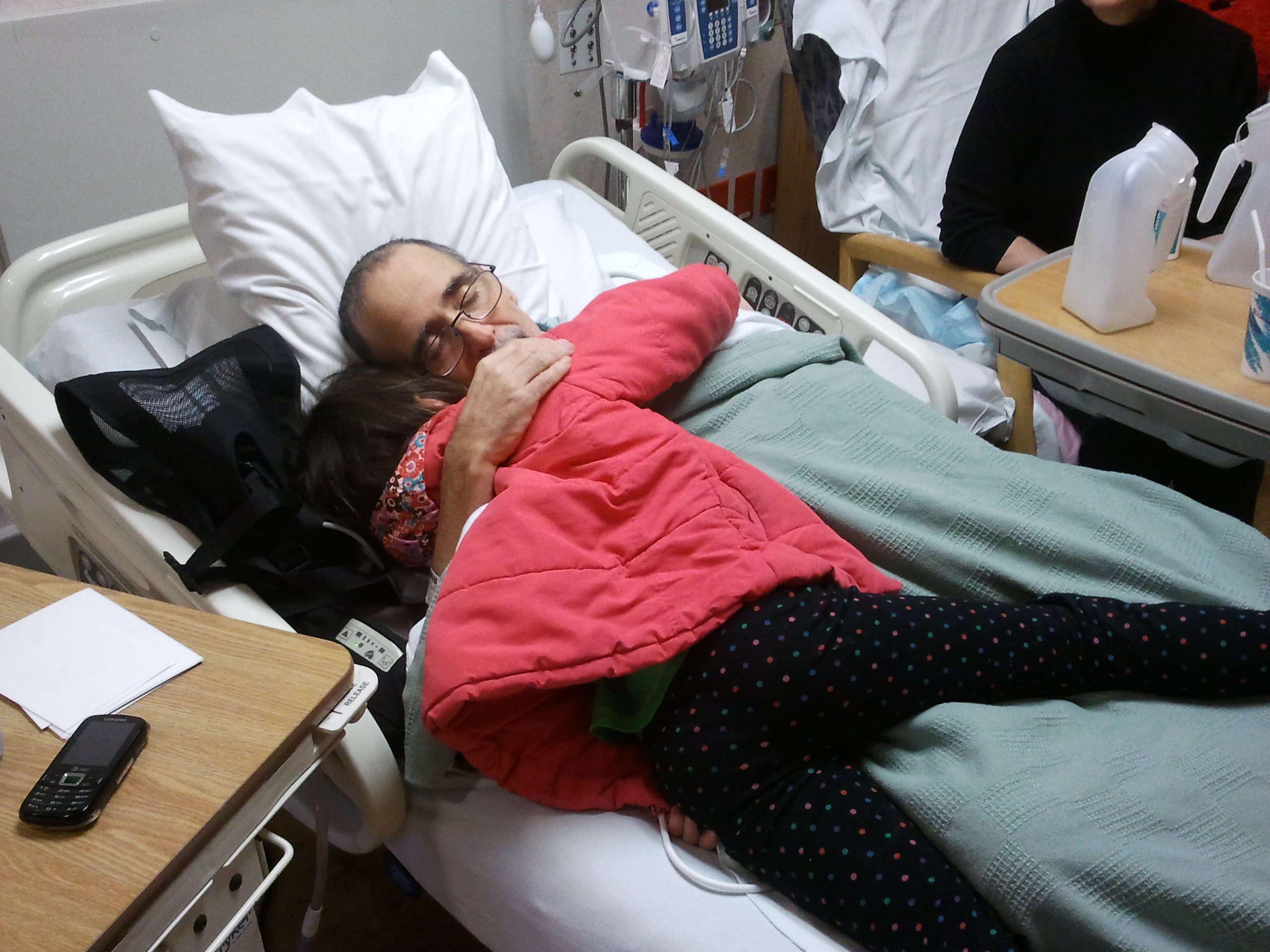
In the rear-view mirror, I saw in my daughter’s eyes the most penetrating concern and hope and love. She just wanted Grandpa to be okay. And I felt the feelings right along with her. I wanted him to live long enough for her to remember him, for my son to get to know him, and for me to tell him I was happy to have him back, warts and all. Thanks to one amazing stranger, one generous donor, that’s exactly what happened:

SAMSUNG